
How Does Corporate Access CRM Track Client Engagement?
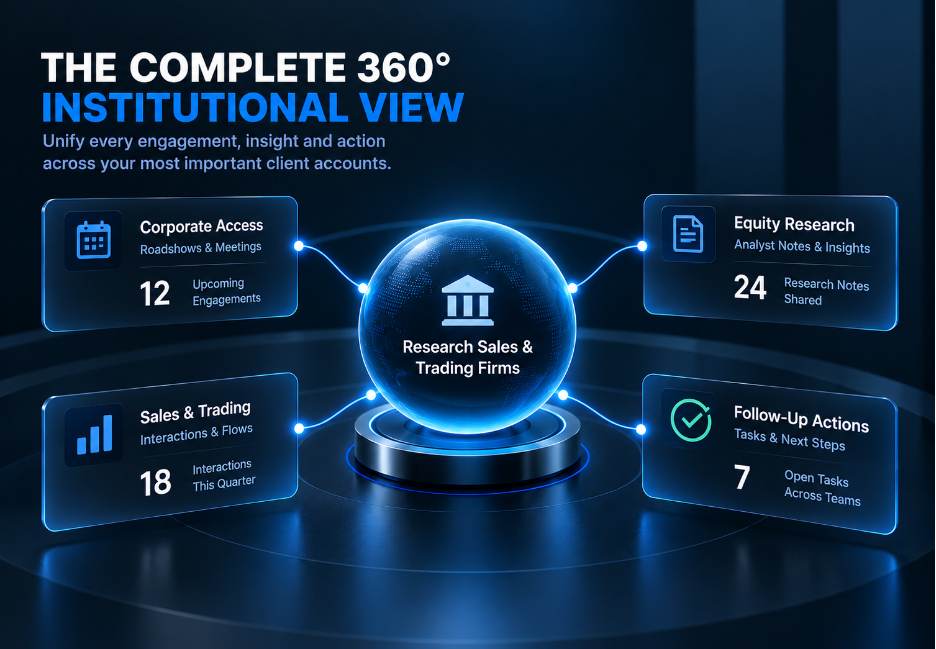
A corporate access conference can generate dozens of investor interactions, yet the real measure of success is not how many meetings were scheduled. It is whether the right investors met the right companies, their interests were understood, and follow-up commitments were fulfilled.
For investment banks, these details often sit across spreadsheets, calendars, and individual inboxes. A corporate access CRM connects meeting activity with institutional client records, helping teams track engagement from initial requests through completed meetings and follow-ups.
This visibility also makes an equity research CRM more valuable by connecting corporate access activity with broader institutional client coverage.
What Is a Corporate Access CRM and Why Does It Matter in Capital Markets?
A corporate access CRM helps investment banks and broker-dealers manage engagement between institutional investors and corporate management teams.
It supports investor targeting, meeting coordination, conferences, participation records, and follow-up management.
Corporate access primarily connects investors with company management. Analyst access, by contrast, facilitates engagement between investors and research analysts. Both are important services within a broader CRM for research sales and trading.
Without connected records, an investor's meeting preferences may be known to one salesperson but invisible to the corporate access team. Centralized corporate access management reduces these information gaps and supports more consistent coverage.
How Does Corporate Access CRM Track Client Engagement?
A corporate access CRM tracks engagement through five connected stages: capturing activity, linking records, confirming outcomes, assigning follow-ups, and reviewing engagement over time.
1. How Is Investor Activity Captured?
Engagement tracking begins before a meeting takes place.
Information can originate from investor invitations, conference registration forms, meeting requests, email conversations, calendar entries, and manually entered feedback.
Email and calendar integrations can reduce duplicate entry, but participation details and qualitative feedback may still require confirmation from coverage professionals.
2. How Are Interactions Connected to Client Accounts?
Each interaction should connect to the relevant investor, institutional account, corporate participant, conference, and responsible coverage professional.
This allows teams to view both individual activity and account-level engagement.
For example, several portfolio managers from one asset management firm may attend different corporate meetings during an investor conference. Connecting their interactions helps the coverage team understand the institution's broader interests rather than treating each meeting separately.
3. How Are Meeting Outcomes Recorded?
A meeting request is not the same as a completed interaction.
An effective tracking process distinguishes between requested, scheduled, and completed meetings, alongside cancellations and feedback where recorded.
A confirmed calendar invitation indicates an intended meeting. Actual participation should be verified through attendance records or post-meeting confirmation.
This distinction prevents inflated engagement reporting.
4. How Are Follow-Ups Managed?
After a meeting, the coverage professional can record investor feedback and assign relevant actions.
A follow-up record should identify the task owner, deadline, and completion status.
For instance, an investor requesting additional research after a corporate management meeting should have that request assigned to the appropriate research or sales professional.
5. How Does Engagement History Guide Decisions?
Connected records help managers identify changes in investor participation, overdue commitments, unmet meeting demand, and uneven account coverage.
Consider an investor requesting meetings with three banking-sector companies during a conference but securing only one. Recording one completed meeting shows activity. Recording two unmet requests reveals a servicing gap.
That distinction turns engagement tracking into actionable relationship intelligence.
Which Client Engagement Metrics Should Capital Markets Teams Monitor?
Meaningful engagement measurement requires distinguishing client preferences, recorded activity, and actual outcomes.
The following are suggested management metrics, not guaranteed standard CRM dashboard fields.
All measures should use consistent reporting periods and clear definitions.
High engagement volume alone does not establish relationship quality. A smaller number of relevant meetings with meaningful follow-through may deliver greater client value.
How Does an Equity Research CRM Support Sales, Trading, and Corporate Access Teams?
An equity research CRM extends relationship visibility beyond individual corporate access conferences.
Research teams can use captured client interests to inform analyst engagement. Institutional sales professionals can coordinate invitations, record feedback, and manage follow-ups. Corporate access teams can manage conference registrations, investor preferences, meeting requests, and scheduling, while sales and trading professionals can review relevant account activity within permitted access rights.
The value of a sales and trading CRM comes from these handoffs. Information should reach the professional responsible for acting on it, not simply remain stored in another system.
How Does InsightsCRM Help Track Corporate Access Engagement?
InsightsCRM, developed by ANALEC, includes dedicated corporate and analyst access management alongside conference management capabilities within its capital markets-focused CRM platform.
Its documented functionality supports the engagement lifecycle through:
- Client and account intelligence: Centralized profiles, chronological interaction histories, preferences, and coverage mapping.
- Email and calendar connectivity: Outlook and Gmail integration, email capture methods, and calendar synchronization.
- Conference management: Investor and corporate invitations, attendee registration, meeting preferences, venue and room management, and meeting-slot allocation.
- Conference-to-CRM tracking: Conference meeting records connected to core CRM engagement information, alongside post-event reporting on meetings, feedback, and notes.
- Follow-up management: Assigned tasks with pending, completed, and overdue activity visibility.
These capabilities connect conference planning and execution with ongoing institutional relationship management.
Firms should validate their required participation statuses, reporting definitions, access permissions, and data-capture processes during implementation.
What Should Firms Evaluate When Choosing a Corporate Access CRM?
Beyond conference scheduling capabilities, buyers should establish whether the platform can distinguish meeting requests from completed interactions, connect activities to institutional accounts, capture meaningful feedback, and report on unmet demand.
They should also assess follow-up ownership, email and calendar integration, reporting flexibility, data security, and role-based access controls.
A tracking system is only as useful as the quality of the records captured and the consistency with which teams use them.
How Can Better Engagement Tracking Improve Corporate Access Delivery?
Corporate access tracking should help firms answer three questions: Which clients are receiving valuable access? Which requests remain unresolved? What should the coverage team do next?
InsightsCRM connects conference management with client activity, meeting information, and follow-up tracking to support more informed institutional servicing.
See how InsightsCRM connects conference meetings, investor feedback, and follow-up activity in an institutional account view.
Book an InsightsCRM demo to explore how its conference management and client engagement capabilities can support your research, sales, trading, and corporate access teams.
FAQs
1. How does a corporate access CRM help investment banks track investor engagement?
A corporate access CRM tracks investor engagement by connecting meeting requests, conference participation, client interactions, and follow-up activities to centralized institutional client profiles. It helps investment banks monitor engagement history, identify investor interests, and assess whether meeting requests and follow-up commitments are being fulfilled. This gives coverage teams better visibility into client relationships and supports more informed engagement planning.
2. What is the role of a corporate access CRM in conference management?
A corporate access CRM supports conference management by organizing investor invitations, attendee registrations, meeting preferences, scheduling, and post-conference activities. It helps corporate access teams coordinate interactions between institutional investors and corporate management while maintaining records of meeting activity. By connecting conference information with client profiles, firms can evaluate participation, capture feedback, and plan future engagement more effectively.
3. Which metrics are important for measuring corporate access client engagement?
Important corporate access engagement metrics include meeting attendance rates, meeting-request fulfilment, follow-up completion, priority-account reach, and feedback coverage. These indicators help investment banks understand investor participation, identify unmet meeting demand, and evaluate client servicing effectiveness. Tracking engagement over time also helps management identify coverage gaps and improve resource allocation.
4. How does an equity research CRM improve coordination between research, sales, and trading teams?
An equity research CRM improves coordination by maintaining shared visibility into institutional client interactions, investment interests, meeting histories, and follow-up responsibilities. Research teams can understand client interests, sales professionals can coordinate relevant engagement, and trading teams can access permitted relationship information. This reduces information gaps, improves accountability, and supports more consistent institutional client coverage.
5. How does InsightsCRM support corporate access engagement tracking?
InsightsCRM supports corporate access engagement tracking through centralized client profiles, interaction histories, conference management, meeting coordination, and task management capabilities. Its conference management functionality connects meeting information with core CRM engagement records and supports post-event reporting on meetings and feedback. These capabilities help investment banks and institutional brokers monitor relationship activity, coordinate follow-ups, and make better-informed client servicing decisions.


