
How Capital Markets CRM Supports Research, Sales and Trading Teams Under One Roof
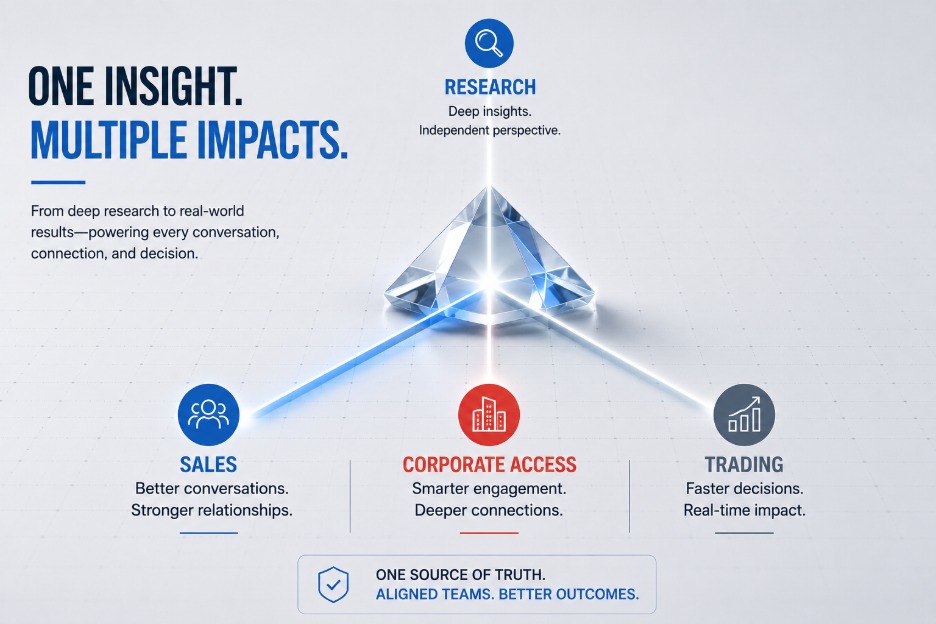
Research, sales, and trading teams do not lose momentum because they lack intelligence. They lose it because intelligence gets trapped in separate workflows. A note is published, a client call happens, market colour comes back, and none of it lands in one shared system. The result is uneven coverage, duplicated outreach, missed follow-ups, and weaker commercial judgment. A capital markets CRM solves that coordination problem by giving front-office teams a shared operating layer built for institutional coverage, not generic sales activity.
A Capital Markets CRM Is Organized by the Desk, Not the Contact Record
A capital markets CRM is designed around institutional coverage, client interaction history, research engagement, account planning, and front-office coordination.
That is a different job from a generic CRM. In capital markets, a client relationship is shaped by multiple desks, overlapping coverage models, event activity, research consumption, analyst access, and revenue potential. A system built for general sales teams usually treats the contact record as the center of gravity. Capital markets firms need the account, the coverage model, and the engagement trail to sit at the center instead.
That is why specialist platforms matter. A strong financial CRM platform gives teams a usable view of who covers an account, what has been sent, what was discussed, what follow-up is pending, and where commercial momentum is building or fading.
Information Breaks at the Handoffs Between Desks
Most firms do not have a research problem or a sales problem in isolation. They have a handoff problem.
When research, sales, and trading operate in separate systems, the same issues show up again and again:
- client conversations are logged in one place while research engagement sits somewhere else
- two teams approach the same account without shared context
- corporate access activity is planned without a clear view of account priority
- meeting notes are captured inconsistently or not at all
- follow-up ownership becomes unclear after calls, roadshows, and conferences
- managers see activity volume, but not whether coverage is aligned to opportunity
- compliance reviews become harder because the interaction trail is fragmented
In a capital markets business, those gaps weaken client service long before they show up in a dashboard. By the time leadership spots the issue, the client has usually felt it first.
Research Becomes a Two-Way Signal, Not a One-Way Publication
A well-implemented equity research CRM changes the role of research inside the firm. Research stops being a publishing function that ends at distribution. It becomes an input into account coverage, follow-up prioritization, and client strategy.
That matters because research teams shape far more than written output. They influence which sectors get attention, which corporates matter most, which investors engage consistently, and which themes are gaining traction with the client base.
When research activity and client engagement live in the same system, firms can:
- track which clients engage with specific research themes
- connect readership patterns to account priorities
- support analyst coverage with clearer client feedback loops
- align corporate access planning to actual investor interest
- give sales teams better context before outreach
- reduce the manual chasing that usually happens after publication
This is where research starts feeding the commercial engine directly. The value is not only better distribution. It is better timing, sharper follow-up, and stronger coordination across desks.
One View of Who Touched the Account, and Why It Mattered
A strong sales and trading CRM gives front-office teams a shared record of account coverage, daily interaction, and next-step ownership.
That sounds simple, but in practice it changes the quality of execution. Sales teams can see who has spoken to the account, what feedback came back, which ideas resonated, and whether the next meeting or task has actually been assigned. Trading teams gain better visibility into the broader relationship, instead of operating off partial context. Managers can assess whether the right level of service is being applied to the right accounts.
The operational gains usually show up in a few specific areas:
- clearer client coverage responsibilities
- better meeting and roadshow coordination
- stronger task and follow-up discipline
- more consistent capture of calls, emails, and notes
- better visibility into account-level activity across the firm
- sharper relationship intelligence for senior decision-makers
- stronger linkage between service effort and revenue outcomes
In capital markets, small execution failures compound quickly. A missed follow-up is rarely just a missed follow-up. It is often a sign that the account is being handled in pieces.
Governance and Commercial Workflow Belong in the Same System
Capital markets firms do not need a CRM that only records activity. They need one that supports the way regulated, high-value client coverage actually works.
That means bringing commercial workflow and control into the same platform: interaction capture, account transparency, permissioning, task discipline, event management, calendar and email integration, mobile access, dashboards, and secure record-keeping.
The point is not to create more process. It is to reduce the amount of work teams do outside process. Once people are managing coverage through side spreadsheets and forwarded email chains, leadership loses visibility, managers lose confidence in the data, and compliance teams end up reconstructing events after the fact.
A purpose-built capital markets CRM keeps the day-to-day workflow close to the record of truth. That is what gives the platform long-term value.
InsightsCRM Was Built Around Broking Reality, Not Retrofitted Into It
InsightsCRM fits this category because it reflects the operating model of research, sales, and trading teams rather than forcing those teams into a generic CRM structure.
Its strength is the combination of client profiling, call-list management, tasking, account transparency, research repository access, content distribution, corporate and analyst access workflows, event support, engagement tracking, dashboards, and mobile usability inside one environment. That matters because these are the moving parts that define institutional client coverage.
For firms, the outcomes are practical:
- better coordination across research, sales, and trading
- faster decisions on account coverage and follow-up
- stronger client relationships built on shared context
- improved management visibility into service levels and opportunity
- tighter execution around meetings, events, and corporate access
- better conditions for revenue growth and cross-team collaboration
What to Pressure-Test Before You Commit
Before choosing a capital markets CRM, firms should pressure-test a few basics:
- Does it reflect your actual coverage model?
- Can it support research, sales, and trading in one operating environment?
- Will teams use it during the day, or only update it afterward?
- Can it capture interactions without adding heavy admin burden?
- Does it support account transparency, task discipline, and event workflows?
- Can management get a real view of activity quality, not just activity volume?
- Does it fit capital markets workflows from day one?
Conclusion
When research, sales, and trading work from disconnected systems, the client experiences the gaps before management sees them. Coverage feels repetitive, follow-ups lose precision, and high-value accounts get managed in fragments instead of as relationships. That is why a purpose-built capital markets CRM matters. InsightsCRM gives firms one clearer view of activity, ownership, and engagement across the desk. If your teams are still piecing together coverage through inboxes and spreadsheets, the real issue is no longer visibility. It is coordination, discipline, and missed revenue. Request a demo with InsightsCRM today!
FAQs
1. What is a capital markets CRM?
A capital markets CRM is a client relationship platform built specifically for institutional firms such as broker-dealers, investment banks, and asset managers. It helps research, sales, and trading teams manage client coverage, track interactions, coordinate follow-ups, and maintain a shared view of account activity.
2. Why is a generic CRM not enough for research, sales, and trading teams?
Generic CRMs are usually designed for broad sales pipelines, not capital markets workflows. They often fall short on account-level coverage visibility, research engagement tracking, corporate access coordination, and the day-to-day collaboration required between research, sales, and trading desks.
3. How does a capital markets CRM improve collaboration between desks?
It gives teams one shared record of client activity, research consumption, meetings, calls, notes, and follow-ups. That reduces duplication, improves handoffs, and helps each desk act with better context instead of relying on separate spreadsheets, inboxes, or manual updates.
4. What features should firms look for in a capital markets CRM?
Firms should look for client and account transparency, interaction capture, task management, research repository access, event and corporate access workflows, email and calendar integration, mobile usability, dashboards, and controls that support compliance and secure record-keeping.
5. Why is InsightsCRM a strong fit for capital markets firms?
InsightsCRM is built around the operating model of research, sales, and trading teams. It supports institutional coverage workflows, account intelligence, tasking, research engagement, event coordination, and management visibility in one platform, helping firms improve coordination, client service, and commercial discipline.


