
CRM Contract Negotiation Checklist for Capital Markets Firms: 12 Questions to Resolve Before You Sign
A CRM contract in capital markets governs more than software access. It can determine how a firm protects relationship intelligence, controls access to confidential transactions, preserves historical interaction data and maintains client coverage when systems or vendors change.
Headline license price is therefore only part of the commitment. Implementation, integrations, data migration, support, user growth and eventual exit can materially alter both cost and operational risk.
This CRM contract negotiation checklist focuses on 12 questions that business sponsors, COOs, technology leaders, procurement, legal, compliance and information-security teams should resolve before signing.
Why Does CRM Contract Review Require Capital-Markets Context?
A CRM can sit across institutional coverage, client servicing, origination, pipeline management and management oversight. Weak CRM vendor contract terms can therefore affect confidentiality, information access, regulatory obligations and continuity of client relationships not simply procurement economics.
What Should Your CRM Contract Negotiation Checklist Cover?
1. What Is the True Total Cost of the CRM?
Clarify licenses, implementation, migration, integrations, configuration, training, support and optional modules. Identify what is included versus separately chargeable.
Watch for: low headline pricing that excludes essential implementation or integration work.
Prefer: transparent pricing assumptions and clearly defined additional charges.
2. How Long Is the Contract, and How Does Renewal Work?
Check the initial term, automatic renewal, notice periods, termination rights and renewal pricing.
A missed notice window should not unexpectedly lock the firm into another lengthy term. Negotiate reasonable notice requirements and visibility over future increases.
3. Who Is Responsible for Implementation and Onboarding?
Define ownership of migration, configuration, testing, training and project management, including dependencies on internal technology teams.
Where appropriate, document milestones, acceptance criteria and escalation procedures. Otherwise, implementation delays can quickly become disputes over responsibility.
4. Who Owns the Relationship and Transaction Data?
Define rights over client and account profiles, coverage relationships, interactions, meeting notes, communications, transaction records, tasks and attachments.
Do not stop at asking whether data is exportable. Confirm whether relationship, interaction and transaction history can be extracted in a usable structure.
Watch for: unclear ownership, proprietary formats or expensive extraction.
Prefer: explicit customer ownership, defined formats, export timelines and deletion obligations.
5. How Will Confidential Client and Transaction Information Be Protected?
CRM contract negotiation for financial services requires scrutiny of confidentiality, entitlements and governance.
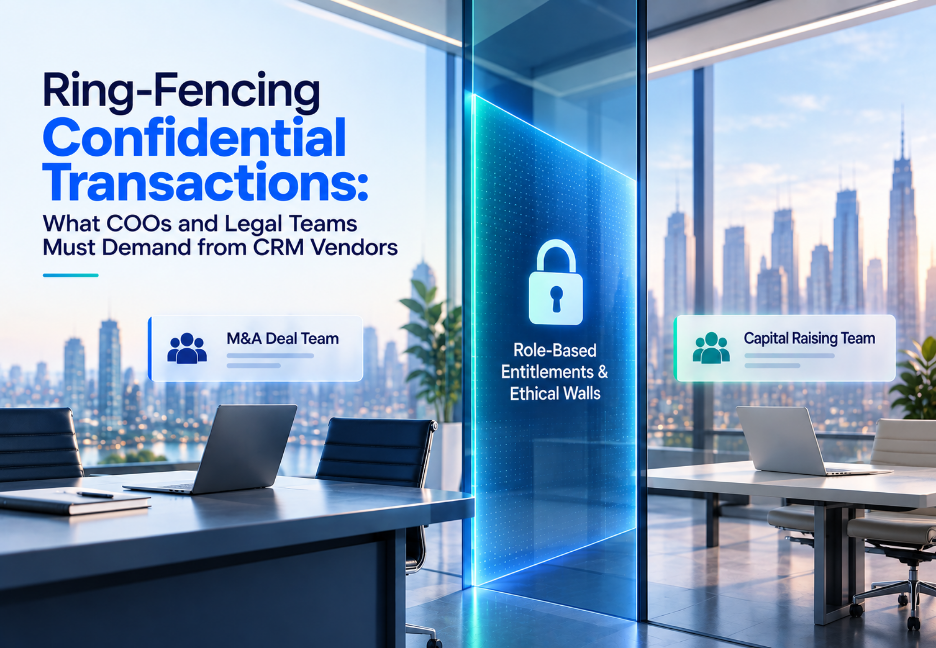
Ask about role-based entitlements, information barriers, audit trails, retention requirements and restricted information. Can confidential transactions be ring-fenced so users outside an authorized deal team cannot access deal information, communications or related records?
Security and compliance teams should also review incident notification, data location, subcontractors and applicable jurisdiction-specific requirements.
6. What Support Model Are You Actually Buying?
Separate support arrangements from contractual availability commitments. Clarify support hours, severity definitions, response times, escalation paths, named contacts and post-go-live support.
A client-facing team needs to know who takes ownership when a critical workflow stops working—not merely how to submit a ticket.
7. What Operational Commitments Should Be Written Into the SLA?
A practical CRM SLA checklist should define availability, restoration targets, maintenance windows, escalation procedures, chronic service failures and remedies.
Watch for: vague availability language or service credits as the only response to repeated failure.
Prefer: measurable commitments, clear escalation and contractual remedies proportionate to operational impact.
8. Who Owns Integration Performance and Failures?
Identify required corporate email/calendar, research, client-data, internal repository and communication-system integrations.
Define responsibility for APIs, maintenance, third-party dependencies and failures. If an email integration stops working and client interactions stop flowing into the CRM, the contract should make accountability clear.
9. Can Workflows and Entitlements Reflect How Your Firm Actually Operates?
An investment banking team may require distinct M&A, ECM, DCM and advisory workflows, with different milestones, deal-team permissions and confidentiality requirements.
Institutional coverage teams may need different account structures and access models. Confirm whether workflows and entitlements based on business unit, coverage responsibility, deal team or need-to-know access can be configured administratively or require paid vendor development.
10. How Will User Licensing and Future Price Changes Work?
Define billable users and treatment of dormant, temporary, administrative and read-only accounts.
Negotiate transparency around additional licenses and future price increases, particularly where adoption may expand across sales, investment, advisory and management teams.
11. Who Remains Accountable After Go-Live?
Establish ownership for support escalation, security incidents, configuration changes, integration failures, releases and ongoing vendor governance.
The contract should make clear who owns the relationship once the implementation team leaves. Operational problems should not disappear between vendor sales, support and technical teams.
12. What Happens to Institutional Knowledge When You Leave?
Exit terms should protect years of accumulated relationship, interaction and transaction history.
Define export rights, transition assistance, usable formats, timelines, charges, retention and deletion procedures. Switching CRM providers should not mean losing the institutional context that coverage and deal teams have built over time.
Which Contract Areas Deserve Particular Attention Before Signing?
What Should Capital Markets Firms Assess Beyond the Contract?
Good contractual protection cannot compensate for poor operational fit. If coverage teams continue keeping critical relationship intelligence in personal inboxes, spreadsheets, notes and disconnected systems, even a strong SLA delivers limited value.
Buyers should therefore assess how the CRM supports frontline behavior, management visibility and governance alongside contractual protections.
Why Should a Capital Markets Firm Consider InsightsCRM When Evaluating Its CRM Options?
InsightsCRM is positioned around customer intelligence and knowledge management for capital-markets workflows. Relevant documented capabilities include configurable workflows, client and account profiling, integrated communications, transaction confidentiality and access controls, and relationship and deal management.
Those capabilities connect directly to several risks in this checklist: controlling access to confidential information, preserving relationship intelligence, supporting differentiated workflows and reducing fragmented client information.
The contract still needs independent scrutiny. Product fit and contractual protection solve different problems, and firms need both.
How Can You Test InsightsCRM Against Your Contract Requirements?
Use these 12 questions during product evaluation rather than waiting until procurement is nearly complete.
Request an InsightsCRM demonstration to assess your real operating requirements, including coverage workflows, confidentiality and entitlements, relationship intelligence, integrations, governance and scalability, before deciding whether the platform and its contractual framework fit your firm.
FAQs
1. What should capital markets firms negotiate in a CRM contract?
Capital markets firms should negotiate beyond license pricing. Key areas include implementation responsibilities, data ownership and portability, role-based entitlements, confidentiality controls, integrations, support, SLA commitments, renewal terms, pricing changes and exit assistance. The objective is to establish clear commercial and operational accountability before the CRM becomes embedded in client coverage and relationship-management workflows.
2. What should be included in a CRM SLA checklist?
A CRM SLA checklist should address system availability, maintenance windows, incident severity levels, response and restoration targets, escalation procedures and remedies for repeated service failures. Firms should distinguish between technical support response times and contractual service commitments, as they address different operational risks.
3. Why is data portability important when negotiating CRM vendor contract terms?
Relationship intelligence accumulates over years and may include client profiles, coverage relationships, interaction histories, communications and transaction records. CRM vendor contract terms should specify data ownership, export formats, extraction timelines, associated charges and deletion obligations. An export right has limited value if the resulting data cannot be migrated or used effectively.
4. What security and confidentiality terms should financial services firms review?
CRM contract negotiation for financial services should examine role-based entitlements, information barriers, audit trails, retention requirements, incident notification and controls over confidential client and transaction information. Where deal-sensitive information is involved, firms should also determine whether access can be restricted to authorized teams on a need-to-know basis.
5. When should CRM contract negotiation begin?
Contract considerations should be introduced during vendor evaluation rather than left until procurement is nearly complete. Reviewing data, integration, confidentiality, workflow, SLA and exit requirements early helps determine whether the proposed commercial agreement matches the firm's actual operating model and reduces the risk of discovering material limitations after vendor selection.


