
Evaluating a Cloud CRM for Investment Banking? 8 Questions IT and Business Leaders Should Ask
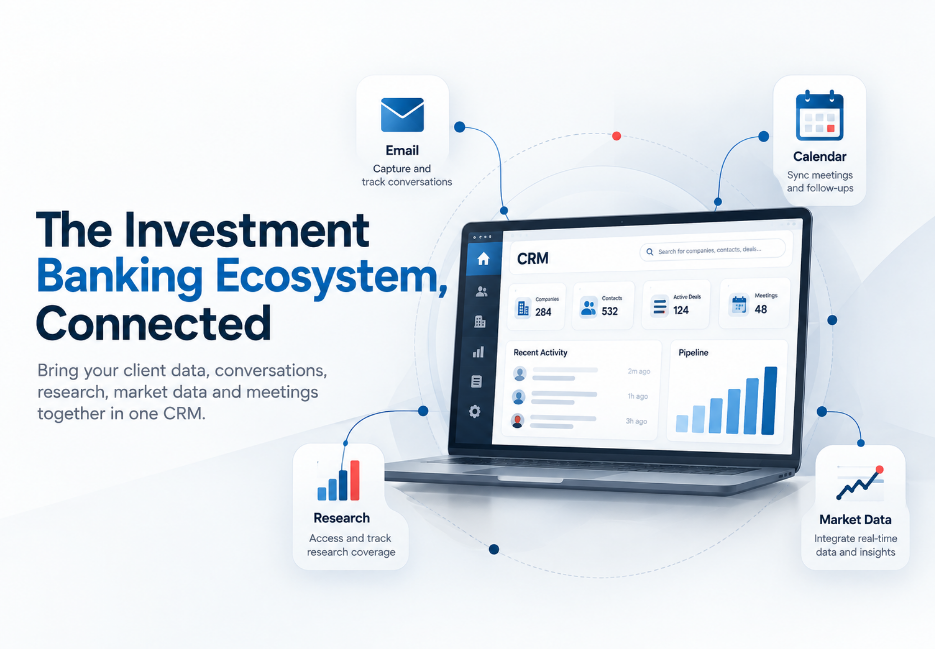
Choosing a CRM for investment banks is not a conventional software procurement exercise.
The system can sit close to some of the firm's most sensitive information: client relationships, prospective mandates, transaction activity, meeting notes, institutional engagement and confidential deal data. It must also work across complex coverage structures while fitting existing email, calendar, research and capital-markets technology.
That creates a difficult balance. IT needs security, resilience and integration. Compliance needs appropriate governance and access controls. Business leaders need relationship intelligence and pipeline visibility. Bankers need a system that does not add administrative friction.
When evaluating a cloud CRM for financial services, these eight questions provide a practical starting point.
1. Can the CRM Meet Investment Banking Security and Compliance Requirements?
Security needs to be assessed around real capital-markets workflows rather than treated as a generic infrastructure checklist.
A CRM may hold transaction information, client correspondence, pipeline data and commercially sensitive relationship intelligence. Firms should therefore examine:
- Role- and user-based access controls
- Transaction-level confidentiality
- Data ownership and governance
- Auditability of important activity
- Backup and recovery arrangements
- Controls governing integrations and data exchange
For investment banking teams, the distinction between relationship visibility and transaction visibility is particularly important. A banker may need access to an institutional relationship history without automatically receiving access to every confidential transaction involving that client.
InsightsCRM publicly describes restricted deal visibility, transaction-level confidentiality and access controls within banking and M&A workflows.
2. Should an Investment Bank Choose a Cloud or On-Premises CRM Deployment Model?
The right CRM deployment model for investment banks depends on the firm's architecture, security policies, regulatory obligations and internal operating model.
Cloud deployment can reduce the infrastructure that an institution must operate directly and can make capacity expansion easier. On-premises deployment can provide greater direct control over infrastructure but places more responsibility for maintenance, upgrades, resilience and capacity management on internal technology teams.
The decision should therefore compare the complete security and operating models rather than assume one architecture is inherently safer. Security and compliance considerations for on-premises CRM remain substantial because the institution itself must maintain many of the underlying controls.
3. What Cloud-Specific Controls Should an Investment Bank Examine?
Moving CRM infrastructure to the cloud changes which questions need to be asked; it does not remove them.
Four areas deserve particular attention.
- Data location: Where is client and transaction information stored and processed, and can the institution select or restrict relevant hosting regions?
- Provider access: Under what circumstances can provider personnel access customer environments or data, and how is that access authorized, monitored and recorded?
- Recovery commitments: What backup, disaster-recovery and service-restoration commitments apply? Firms should understand both recovery time objectives and how much recent data could potentially be lost following a major incident.
- Data portability: How can the institution export its data if requirements change, the contract ends or a future migration becomes necessary? Portability should include usable data structures, not simply raw files that are difficult to reconstruct.
These questions belong in technical and vendor due diligence before cloud architecture is treated as an operational benefit.
4. Can the CRM Integrate With the Capital-Markets Technology Stack?
A CRM that becomes another information silo solves very little.
Investment banks should examine how the platform interacts with corporate email, calendars, telephony, cloud storage, virtual meeting tools, research systems, market or reference data and other internal platforms supporting coverage and deal execution.
InsightsCRM's public product information describes integrations across email, virtual meetings, telephony, cloud storage and third-party data services.
The operational test is straightforward: can bankers work through familiar tools while relevant activity is captured in the CRM? Requiring duplicate entry can undermine adoption.
5. How Does the CRM Manage Client, Relationship and Deal Data?
A useful CRM for investment banks needs to connect more than contacts.
Senior teams need a coherent view of organizations, individual stakeholders, coverage relationships, interactions, opportunities and active transactions. Otherwise, valuable intelligence remains scattered across spreadsheets, inboxes and personal notes.
Evaluation should cover the ability to:
- Maintain organization and individual profiles
- Track interactions and follow-ups
- Map relationship and coverage ownership
- Connect relationships with mandates and transactions
- Restrict sensitive information appropriately
- Produce management views of pipelines and engagement
InsightsCRM positions centralized client coverage and interaction history as part of its capital-markets operating model.
6. Can the CRM Scale as Teams, Regions and Transaction Volumes Grow?
Scalability is not simply a question of adding users.
As the organization grows, the CRM may need to accommodate more jurisdictions, product groups, reporting hierarchies, integrations, client structures and confidential transactions.
IT leaders should ask whether access models and integrations remain manageable at higher volumes. Business leaders should ask whether management can still understand coverage intensity, pipeline progress and relationship activity without rebuilding the picture manually.
The system should become more valuable as institutional knowledge accumulates—not more difficult to govern.
7. Can the CRM Adapt to Investment Banking Workflows Without Excessive Customization?
Standard sales workflows often need significant adaptation before they can represent mandate origination, transaction qualification and deal execution.
Investment banking may involve distinct processes for M&A, ECM, DCM, advisory and corporate coverage. Each can require different milestones, participants, confidentiality controls and follow-up logic.
InsightsCRM publicly describes support for custom deal stages, capital-markets workflows and transaction-level confidentiality.
Configurability matters, but there is a trade-off. Excessive bespoke development creates technical debt. Firms should look for a platform that reflects their operating model without making every workflow change an IT project.
8. Will the CRM Achieve Adoption and Deliver Long-Term Business Value?
A technically capable CRM has limited value if bankers do not use it consistently.
Evaluation should focus on everyday activities: capturing email and meetings, reviewing client history, assigning tasks, updating deals, recording follow-ups and accessing information while travelling. InsightsCRM's public materials describe email and calendar integration, tasks, mobile access, interaction history and deal tracking within its capital-markets environment.
Total cost should also extend beyond licensing. Consider implementation, data migration, integrations, configuration, support, upgrades, internal administration and future change.
Why Is InsightsCRM Relevant for Investment Banking and Capital Markets?
InsightsCRM is positioned specifically around capital-markets customer engagement and deal management. Its public product information covers centralized relationship intelligence, transaction workflows, third-party integrations, deal confidentiality and management visibility rather than positioning the platform as a generic sales CRM.
That makes the relevant evaluation question broader than whether the platform is cloud-based. The real issue is whether it can fit the firm's coverage model, governance requirements and transaction workflows while giving senior management better visibility into client relationships and deal activity.
For firms reassessing their CRM architecture, the next step should be practical: evaluate InsightsCRM against your own M&A, ECM, DCM, client-coverage and confidentiality workflows, and test how those processes would operate in the platform. To see how InsightsCRM fits your coverage, confidentiality and deal workflows, request a demo.
FAQs:
1. What Should Investment Banks Look for in a Cloud CRM?
Investment banks should assess security, transaction confidentiality, data governance, integration, scalability, workflow flexibility and user adoption. A suitable CRM should support capital-markets relationship structures and deal processes rather than simply replicate a generic sales pipeline.
2. Is a Cloud CRM Secure Enough for Investment Banking?
A cloud CRM can be appropriate for investment banking, but security depends on the provider’s controls and the institution’s own governance requirements. Firms should examine data location, provider access, backup and recovery commitments, access controls, auditability and data portability before making a decision.
3. How Does a CRM Support Investment Banking Deal Management?
A CRM for investment banks can help centralize mandate origination, transaction activity, client interactions, deal milestones and follow-ups. It can also improve pipeline visibility while applying appropriate confidentiality controls around sensitive deal information.
4. What Is the Difference Between Cloud and On-Premises CRM for Investment Banks?
Cloud CRM typically reduces the amount of infrastructure managed internally and can make scaling and upgrades easier. On-premises CRM gives the institution more direct infrastructure control but also places greater responsibility on internal teams for maintenance, security, resilience and capacity.
5. Why Is User Adoption Important When Evaluating a CRM for Investment Banks?
CRM value depends heavily on consistent data capture. If bankers find the system difficult to use or are required to duplicate information across multiple platforms, adoption can weaken. The strongest implementations fit naturally into daily activities such as email, meetings, tasks, client coverage and deal updates.


