
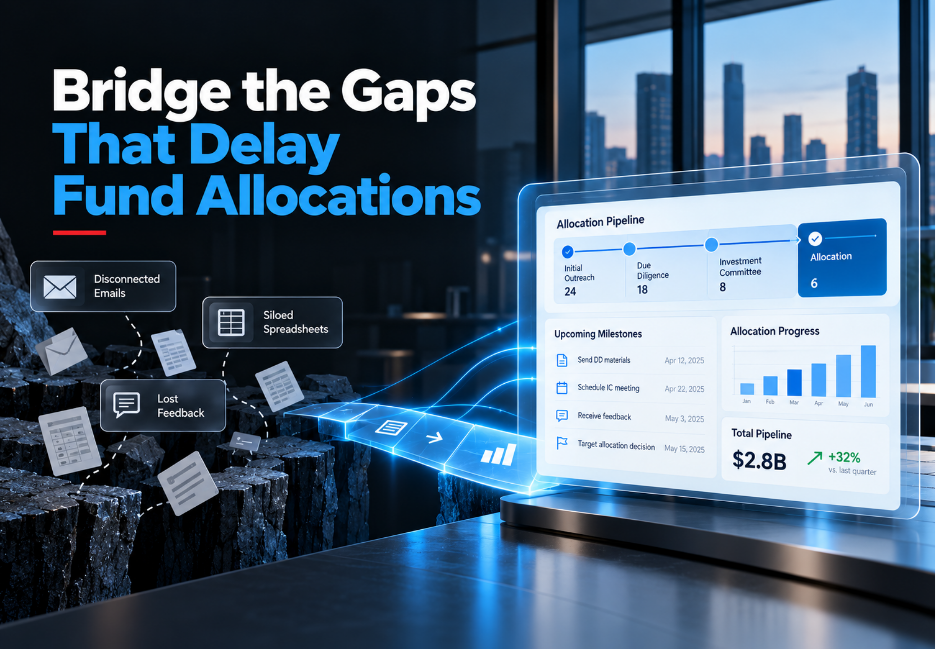
An institutional investor requests additional fund information ahead of an investment committee meeting. The relationship manager has the original discussion notes, but the due-diligence questions sit in another colleague’s inbox. Meanwhile, the distribution head has no visibility into the investor’s expected decision date.
Such information gaps can delay fund allocations and weaken institutional relationships.
For institutional asset managers, distribution, business-development, and investor-relations teams, relationship intelligence is essential to winning mandates and growing assets under management (AUM). An investment management CRM helps connect investor information, engagement activities, and commercial opportunities so teams can act with greater consistency.
What Are the 9 Data and Relationship Gaps Investment Management Firms Need to Address?
1. Why Does Fragmented Investor Data Create Blind Spots?
Investor information scattered across spreadsheets, emails, and legacy systems makes it difficult to establish a reliable investor profile.
Impact: Teams may work with outdated contact details, incomplete investment mandates, or conflicting records.
Solution: Centralize institutional profiles, investment preferences, mandate requirements, and key contacts.
Diagnostic question: Can your team access an investor’s current mandate requirements without consulting multiple systems?
2. How Do Poor Relationship Maps Affect Institutional Mandates and Fund Allocations?
Institutional allocation decisions often involve investment consultants, fund selectors, investment committees, and senior decision-makers.
Impact: Engaging one contact without understanding other stakeholders can leave important investment objections unresolved.
Solution: Map decision-makers, influencers, relationship owners, and approval responsibilities.
For example, identifying an investment consultant’s involvement early can help distribution teams prepare relevant due-diligence materials.
3. Why Do Investment Firms Struggle to Track Investor Interactions?
Meeting notes, investor feedback, and email discussions frequently remain with individual relationship managers.
Impact: When coverage responsibilities change, valuable context disappears and investors may need to repeat earlier discussions.
Solution: Maintain chronological interaction records capturing discussion topics, investor concerns, agreed actions, and communication history.
4. How Can Weak Pipeline Visibility Affect Fundraising Opportunities?
Fundraising opportunities progress through identifiable stages, from initial engagement and due diligence to investment committee review and allocation.
Impact: Without tracking expected decision dates and outstanding requirements, promising opportunities can remain inactive.
Solution: Use a CRM for investment firms to monitor opportunity stages, potential allocation amounts, decision timelines, and next actions.
5. Why Are Siloed Teams a Challenge for Investment Management Firms?
Distribution, investor relations, and investment teams often work with different information despite serving the same institutional relationships.
Impact: Business-development teams may commit to providing portfolio information without coordinating with the investment team.
Solution: Establish shared workflows, defined responsibilities, and appropriate access permissions so internal teams can coordinate investor servicing.
6. How Does Incomplete Investor Data Limit Personalized Engagement?
Institutional investors differ in investment objectives, risk tolerance, geographic interests, and product preferences.
Impact: Sending irrelevant fund information can weaken engagement and consume relationship managers’ time.
Solution: Capture investor interests, product suitability considerations, previous feedback, and preferred communication methods to support more relevant outreach.
7. Why Do Manual Reporting Processes Delay Business Decisions?
Preparing fundraising updates and relationship activity reports often requires consolidating information from multiple employees.
Impact: Reporting becomes time-consuming, and management receives information that may already be outdated.
Solution: Standardize activity and opportunity data capture to support consistent pipeline reports and reduce manual reconciliation.
8. How Can Weak Follow-Up Processes Lead to Missed Allocations?
Institutional investors frequently request performance information, investment presentations, and due-diligence responses before making allocation decisions.
Impact: Unassigned requests or missed deadlines can interrupt investment reviews and damage confidence.
Solution: Record every commitment with a responsible owner, deadline, and completion status.
Diagnostic question: Can your team immediately identify overdue investor requests and the person responsible?
9. Why Is Limited Management Visibility a Risk for Investment Firms?
Senior management needs more than a list of prospects. Leadership must understand relationship coverage, pipeline progression, and where opportunities are stalling.
Impact: Without reliable oversight, management may misallocate distribution resources or overlook under-serviced institutional accounts.
Solution: Consolidated dashboards can highlight prospecting activity, stalled opportunities, outstanding commitments, and coverage gaps.
How Can an Investment Management CRM Help Close These Gaps?
A purpose-fit CRM for investment management connects investor intelligence with relationship workflows.
Successful implementation still requires reliable data, clear ownership, appropriate permissions, and consistent employee adoption.
Why Should Capital Markets Firms Consider InsightsCRM?
InsightsCRM supports institutional asset-management teams through investor profiling, prospecting management, product-opportunity alignment, task management, and reporting.
Consider a distribution manager engaging a pension fund. The team records the investor’s mandate preferences, captures feedback following a fund presentation, assigns responsibility for requested documentation, and tracks the prospect through its allocation process.
InsightsCRM brings these related activities into a connected relationship-management workflow, helping teams maintain continuity and improve accountability.
For firms evaluating investment management CRM software, this operational alignment is often more valuable than maintaining a larger contact database.
How Can Investment Management Firms Choose the Right CRM?
When evaluating an investment firm CRM, consider:
- Does it support institutional fundraising and investor-servicing workflows?
- Can it capture stakeholder roles, mandate preferences, and engagement history?
- Does it provide clear opportunity stages and follow-up ownership?
- Can management identify stalled allocations and coverage gaps?
- Does it support existing technology, governance, and access requirements?
- Can the vendor demonstrate these workflows using realistic institutional scenarios?
How Can InsightsCRM Help Your Firm Build Stronger Relationships?
Institutional relationship management depends on accurate information, coordinated engagement, and disciplined execution.
Addressing these nine gaps can help investment firms protect relationship continuity, improve prospecting accountability, and make better-informed business decisions.
Ready to strengthen your investor engagement strategy? Explore how InsightsCRM can support your investment management CRM requirements.
FAQs
1. What is an investment management CRM, and why do investment firms need one?
An investment management CRM is a relationship management platform that helps investment firms organize investor information, track interactions, manage fundraising opportunities, and coordinate client engagement. It provides distribution, business-development, and investor-relations teams with a consolidated view of institutional relationships, reducing information gaps and supporting more informed decisions.
2. How does a CRM help investment firms improve investor relationships?
A CRM for investment firms helps teams maintain detailed investor profiles, track communication history, record investment preferences, and manage follow-up activities. By providing access to relevant relationship intelligence, it enables relationship managers to deliver more personalized engagement, maintain continuity across teams, and respond effectively to investor requirements.
3. How can investment management CRM software improve fundraising and pipeline visibility?
Investment management CRM software helps firms track institutional prospects throughout the fundraising lifecycle, from initial engagement and due diligence to investment committee reviews and potential allocations. By recording opportunity stages, expected decision dates, outstanding requirements, and relationship ownership, it allows management to identify stalled opportunities and prioritize business-development efforts.
4. What features should investment firms look for in a CRM?
Investment firms should prioritize centralized investor profiles, stakeholder relationship mapping, interaction tracking, opportunity management, task reminders, and management reporting. A suitable investment firm CRM should also support institutional investment workflows, integrate with existing technology, and provide appropriate access controls to protect sensitive investor information.
5. How does InsightsCRM support institutional asset management firms?
InsightsCRM helps institutional asset management firms manage investor relationships, prospecting activities, product-opportunity alignment, and follow-up responsibilities. Its client profiling, interaction tracking, task management, and reporting capabilities help distribution and investor-relations teams maintain organized relationship information, improve internal coordination, and support more informed engagement throughout the investor acquisition lifecycle.


